URBANFLOODS
URBANFLOODS: Strengthening Flood Resilience Across the Adriatic-Ionian Region
URBANFLOODS project aims to raise public awareness, suggests guidelines for flood prevention, and provides strategic action plans for the short, medium, and long term. The project is designed to benefit local authorities, communities, policymakers, and the public, who should consider these recommendations for building more flood-resilient cities in the future.
Project info box
- Name of the project: URBANFLOODS: Strengthening Flood Resilience Across the Adriatic-Ionian Region
- Source of funding: Interreg IPA-Adrion
- Implementation period: from 01/09/2024 to 31/08/2027
- Total budget€ - 1.747.583,17 € (80% EU contribution - 85% IPA contribution)
- Website: https://urbanfloods.interreg-ipa-adrion.eu/
Project’s description:
The Adriatic-Ionian region, with its unique geographical and climatic conditions, is increasingly susceptible to severe floods due to the combination of climate change and land use. These events have led to significant geomorphological changes in river channels and, historically, have caused considerable damage to lives, property, agriculture, and tourism infrastructure.
The goal of the URBANFLOODS project is to strengthen urban resilience against the growing threat of floods, particularly targeting rivers and streams in urban areas within the Adriatic-Ionian region. By developing an integrated decision support system in accordance with the EU Floods Directive and an innovative communication and learning platform, the project aims to transform flood management and preparedness.
Specific objectives of the project
- Joint Development of an Integrated Decision Support System (DSS): Involves creating an advanced data-driven system that offers comprehensive solutions for flood management and early warning systems.
- Strengthening Natural and Civil Protection Mechanisms: Focuses on improving existing strategies for natural and civil protection and introducing new measures to further safeguard the Adriatic-Ionian region from flood risks.
- Analysis of Established Protocols for Effective Practices, Transnational Strategies, and Action Plans: A process that includes identifying, documenting, and adopting successful flood management strategies and action plans, which can serve as a reference for other regions facing similar challenges.
- Education of Local Communities: Aims to enhance the understanding of flood risks among local communities by encouraging a culture of "preparedness" and promoting proactive measures to mitigate potential impacts.
Main expected results
- Unified DSS: A single, integrated DSS will enhance the capacity of local authorities to mitigate urban flood risks and increase urban resilience by offering sophisticated, data-driven flood management solutions. This unified DSS will be validated and demonstrated across nine different pilot locations.
- Transnational URBANFLOODS Strategy: A comprehensive transnational strategy will be established to achieve efficient and effective flood management. This strategy will provide a shared vision, goals, objectives, policies, actions, and measures, all based on a data-driven approach.
- Three Action Plans: Three action plans will be developed to translate the transnational strategy into actionable steps. These plans aim to enhance knowledge and support decision-making across three key categories of institutions: (1) local/regional authorities, (2) civil protection agencies, and (3) national authorities.
- Memorandum of Cooperation: A formal agreement among partners to continue collaboration post-project completion. This memorandum will promote knowledge exchange and the transfer of best practices among partners and relevant stakeholders, increasing the visibility of project outcomes to support future synergies and raise public awareness and preparedness, thereby maximizing the project's potential impact.
PARTNERS
- University of Western Macedonia, Department of Electrical and Computer Engineering – Greece (EL) – Lead Partner
- Hydro-engineering Institute Sarajevo – Bosnia and Herzegovina (BA)
- Development centre Murska Sobota – Slovenia (SI)
- Macerata Municipality– Italy (IT)
- Regional development agency Backa – Serbia (RS)
- Municipal Enterprise for Water Supply and Sewerage of Kozani – Greece (EL)
- Hydrowater-Albania sh.p.k – Albania (AL)
- Rijeka Development Agency Porin Ltd. – Croatia (HR)
- Faculty of Computer Science and Engineering, Ss. Cyril and Methodius University in Skopje – North Macedonia (MK)
- EuroMediterranean Center for the Sustainable Development – SVI.MED NPO – Italy (IT)
- Center for Knowledge Management CKM – North Macedonia (MK)
Associated partners
- Municipality of Scicli – IT
- Municipality of Modica – IT
- Slovenian Environment Agency (ARSO) – SI
- Agency for watershed of the Adriatic Sea – BA
- Water Supply and Sewerage Association of Albania – AL
- MINISTRY OF ENVIRONMENT AND ENERGY, GENERAL DIRECTORATE FOR WATER – EL
- Public Water Management Company “Vode Vojvodine” – RS
- Municipality of Kozani – EL
- Centre for Crisis Mangement – MK
- Institute of Sustainable Development and Management of Natural Resources-UCRI TEMENUS UOWM – EL
- Public Institution for protected area management in the Primorje-Gorski Kotar County – HR
Pilot sites
- Siopoto - Greece
- Matica river - Bosnia & Herzegovina
- Ledava river - Slovenia
- Fosso Narducci - Italy
- Modica-Scicli torrent - Italy
- Karaš river - Serbia
- Tirana river - Albania
- Rjecina river - Croatia
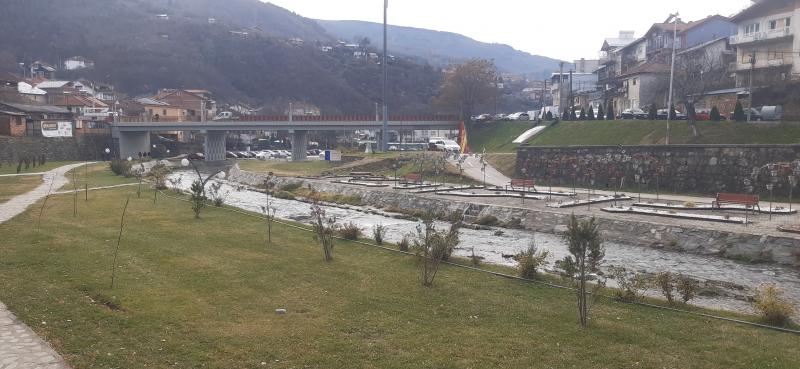
- Kriva Reka river - North Macedonia
News
- Information about First National Stakeholders’ Meeting in North Macedonia URBANFLOODS project - Date of publication: 26.3.2025
- Information about Second transnational URBANFLOODS Meeting held in Rijeka - Date of publication: 23.4.2025
- Kriva Reka: Building flood-resilient communities through URBANFLOODS Project - Date of publication: 20.6.2025
- Urban Flooding in North Macedonia: Managing Risk in a Changing Climate - Date of publication: 23.6.2025
- New station on the Kriva River Basin for improved urban flood management within the UrbanFloods project - Date of publication: 29.8.2025
Contacts
- Boro Jakimovski - boro.jakimovski@finki.ukim.mk
- Andreja Naumoski - andreja.naumoski@finki.ukim.mk
The URBANFLOODS project is co-funded by the European Union through the Interreg IPA ADRION Programme.